

Here’s the deal: you bought a new HVAC system in 2025 and heard you might be able to get a Federal tax credit. But how do you go about it? The great news is you can claim it when you file your income taxes in 2026, so now is the time to act!
The best part? For qualified HVAC improvements, homeowners might be able to claim 25c tax credits equal to 30% of the install costs (up to a maximum of $2000).
If you’re unsure of how to get the tax credit you might be eligible for, don’t worry. We’ve got you covered! Read on through this post to learn about the eligibility criteria of the federal tax credit scheme for high efficiency HVAC systems, and find out how you can claim some money back.
And for any other heating or cooling worries you may have, remember that SuperTech is Baltimore's best HVAC contractor!
Concerned About Your HVAC? We'll Take Care Of It In A Flash!
What is the Federal Tax Credit For High Efficiency HVAC Systems?
The nonbusiness energy property tax credit provides an incentive for homeowners to invest in energy-efficient home improvements, such as high efficiency heating, cooling, and water-heating equipment. It’s a non-refundable personal tax credit, i.e., reducing taxes, dollar-for-dollar. It was enacted as part of the Energy Policy Act of 2005 and has been expanded multiple times, now through December 31st, 2025.
Why is this important? Well, this means that any purchase of a qualifying high efficiency HVAC system throughout 2025 is covered by the tax credit.
How Does Energy Tax Credit Work and How Much Will I Be Given?
Although it sounds quite complicated, once you get to know the details, it’s not too difficult to understand. Thanks to the tax credit, homeowners will receive a credit against their taxes for an amount equal to 30% of the amount paid or incurred up to $2000 or a specific amount from $600 – $2000.
We won't lie, there are some specifics you need to be aware of. In the following section, we use some abbreviations, which are explained below:
- SEER – Seasonal Energy Efficiency Ratio, which measures how much heat is removed by an AC or Heat Pump in watt-hours. The higher the ratio, the more energy efficient.
- EER – Energy Efficiency Ratio. It measures how efficient an AC or Heat Pump operates when the outdoor temperature is 95F or higher.
- HSPF – Heating Seasonal Performance Factor. It measures the ratio of heat output from a Heat Pump to electricity used.
- AFUE – Annualized Fuel Utilization Efficiency. It’s a percentage used to rate the heating efficiencies of furnaces. The higher the percentage, the more energy efficient.
- COP – Coefficient of Performance. It measures the ratio of heating or cooling output to the amount of energy consumed by a Heat Pump or HVAC system. The higher the COP, the more energy efficient the system.
- UEF – Uniform Energy Factor. It measures the overall energy efficiency of water heaters based on typical household usage patterns. The higher the UEF rating, the more energy efficient the water heater.
How Do I Find Out The SEER, EER, HSPF, AFUE, COP And UEF Of My HVAC System?
The best way to find out this information is to contact the HVAC contractor who installed your system. Here at SuperTech, we provide that information in our install contracts, and if you’re unsure, you can always give us a call!
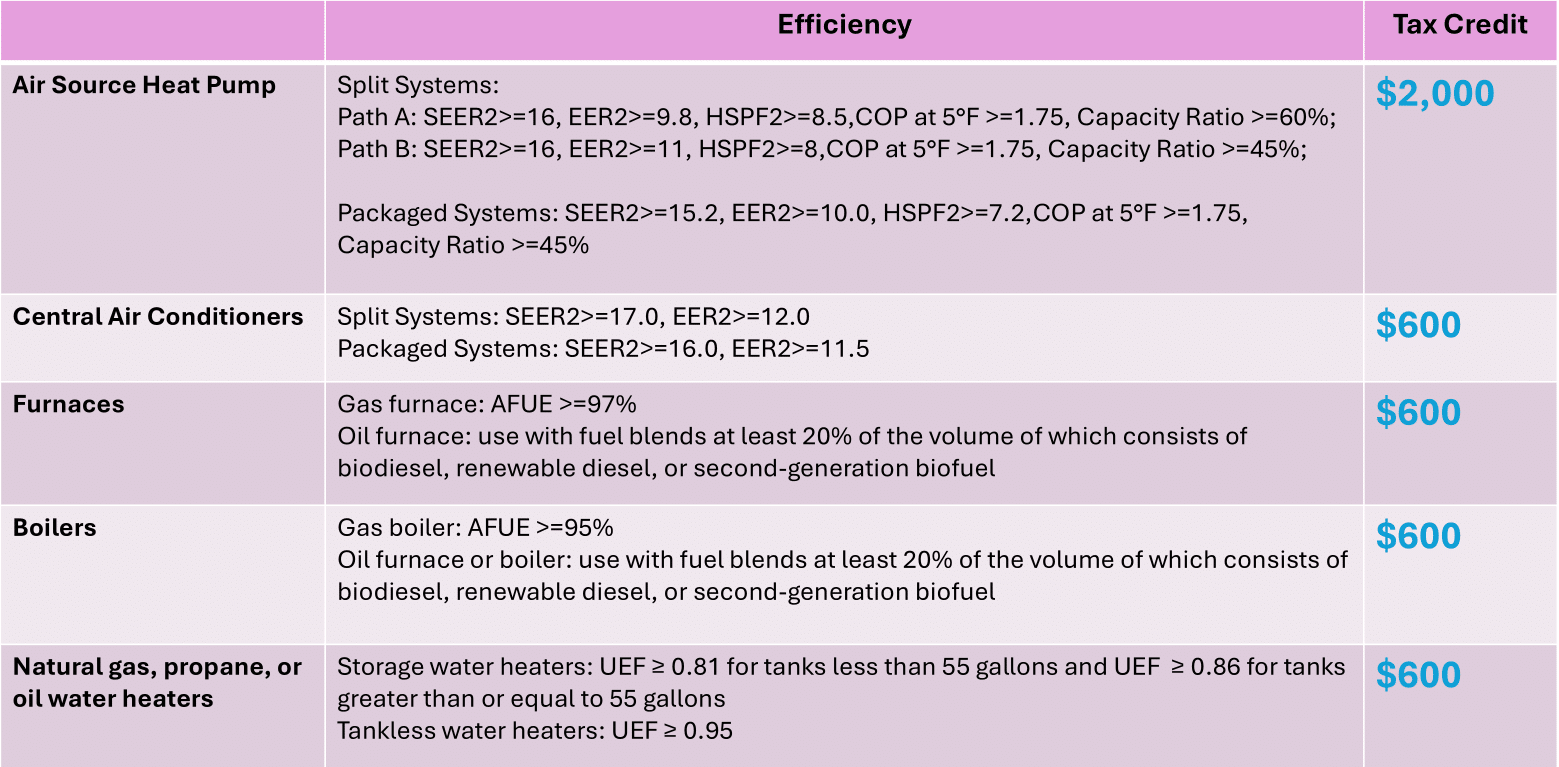
Air Source Heat Pumps
For these systems, homeowners may qualify for a federal tax credit of up to $2,000. To be eligible, the heat pump must meet minimum efficiency requirements of 16 SEER2, 9.8 EER2, and 8.0 HSPF2, depending on the certification path. Path A applies to heating-dominated and whole-home electrification scenarios, while Path B criteria are intended for cooling-dominated applications and partial displacement scenarios, such as dual-fuel heating systems.
Central Air Conditioners
With these, you can qualify for tax credit up to $600. Split systems must have a minimum of 17 SEER2 and 12 EER2 whereas packaged systems must meet or exceed 16 SEER and 11.5 EER.
Furnaces
With these kinds of furnaces, you can qualify for tax credit up to $600. They must meet or exceed a 97% AFUE for gas furnace.
Boilers
For these, you can qualify for tax credit up to $600. They must meet or exceed a 95% AFUE for gas fired boiler.
Natural Gas, Propane, or Oil Water Heaters
For these water heaters, you can qualify for tax credit up to $600. Storage water heaters must have a minimum of 0.81 UEF whereas tankless water heater must meet or exceed 0.95 UEF.
Am I Eligible To Claim HVAC Rebate?
It sounds great, doesn’t it? But what’s the bottom line? How do you know if you’re eligible?
First of all, if the system meets the qualifications in the section above, it’s energy star certified. This proof is often in the form of an AHRI certificate or a manufacturer certification. As a homeowner, you should keep proof for your own records, but you don’t need to attach them to your tax return when you file. In addition, to be eligible for the tax credit, the system must be installed at your existing home, which is also your primary residence.


Unfortunately, tax credits are not available for new constructions or rentals. They're only for systems that you replaced or added at your current home.
The previous $500 lifetime limit ended in 2022. Currently, homeowners may qualify for new annual tax credits of up to $600 for certain HVAC systems such as central air conditioners, furnaces, boilers, or water heaters, and up to $2,000 for qualifying heat pumps.
SuperTech Helps With So Much More Than Claiming Tax Credit
How To Claim Residential Energy Credit?
First things first, to claim your tax credits, be sure to keep a copy of the manufacturer’s certification statement to show the efficiency ratings of the system. You won’t qualify for the credits without one.
In order to apply for the tax credit, you need to file IRS Form 5695 with your tax return. The following section provides a step-by-step guide to completing Form 5695 to claim federal tax credits for your HVAC system.
Step 1: Download The Relevant Forms
Understanding how to complete IRS Form 5695 to claim your tax credits can be challenging, which is why we’ve included this super simple, easy-to-follow step-by-step guide to completing the form. Here’s everything you need to know:
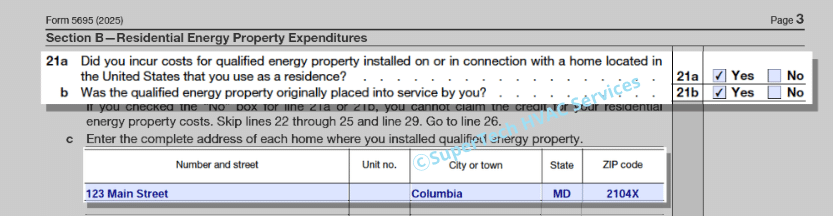
Step 2: Complete Lines 21a, 21b, and 21c in Section B of Form 5695
Beginning in 2023, the Energy Efficient Home Improvement Credit uses annual limits instead of a lifetime limit. This means homeowners may claim the credit each year for eligible improvements, as long as the annual limits are not exceeded. If you are unsure about your eligibility, consider consulting a tax professional. The examples below show how to complete the form.
Assuming you paid for a qualified energy-efficient HVAC system installed in your home in the United States, and you use the home as a residence.
Assuming the system was installed at 123 Main Street, Columbia, MD 2104X:
- Select “Yes” on Line 21a
- Select “Yes” on Line 21b
- On Line 21c, enter the installation address: 123 Main Street, Columbia, MD 2104X
You will also need to enter the Qualified Manufacturer Identification Number (QMID) for the manufacturer of the HVAC system you installed. For example:
- Lennox: L7S0
- Mitsubishi: E8X7
- Bosch: K3M2
If your manufacturer is not listed above, contact your HVAC installer to obtain the QMID.
Step 3: Complete the remaining relevant sections of Form 5695
To complete the remaining sections of form 5695, you can follow the five scenarios/examples below. Click on the example that matches your situation:
Scenario 1: Qualified Heat Pump System (no furnace)
If you paid $10,000 for one Lennox qualified central A/C only (no furnace):
- Enter L7S0 (Lennox) and $10,000 on Line 22a
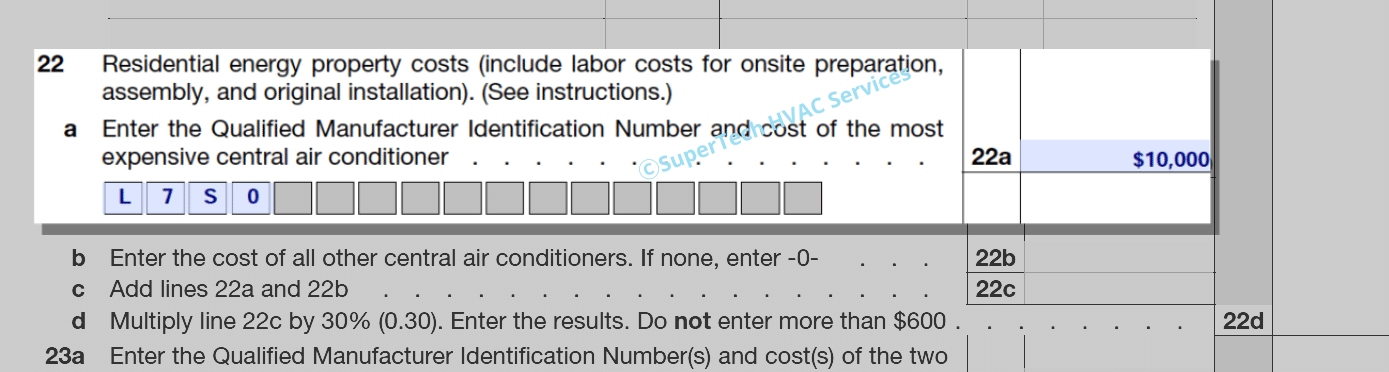
- Enter $0 on Line 22b, $10,000 on Line 22c and $600 on Line 22d
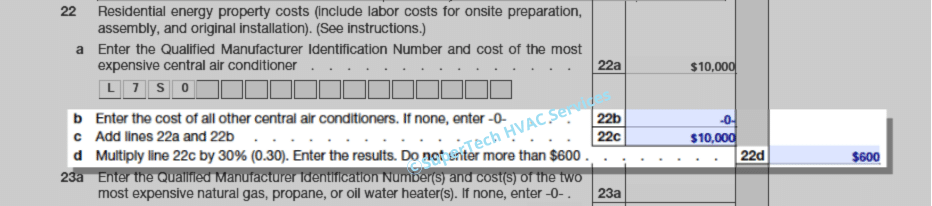
- Enter $600 on Lines 27, 28, and 30
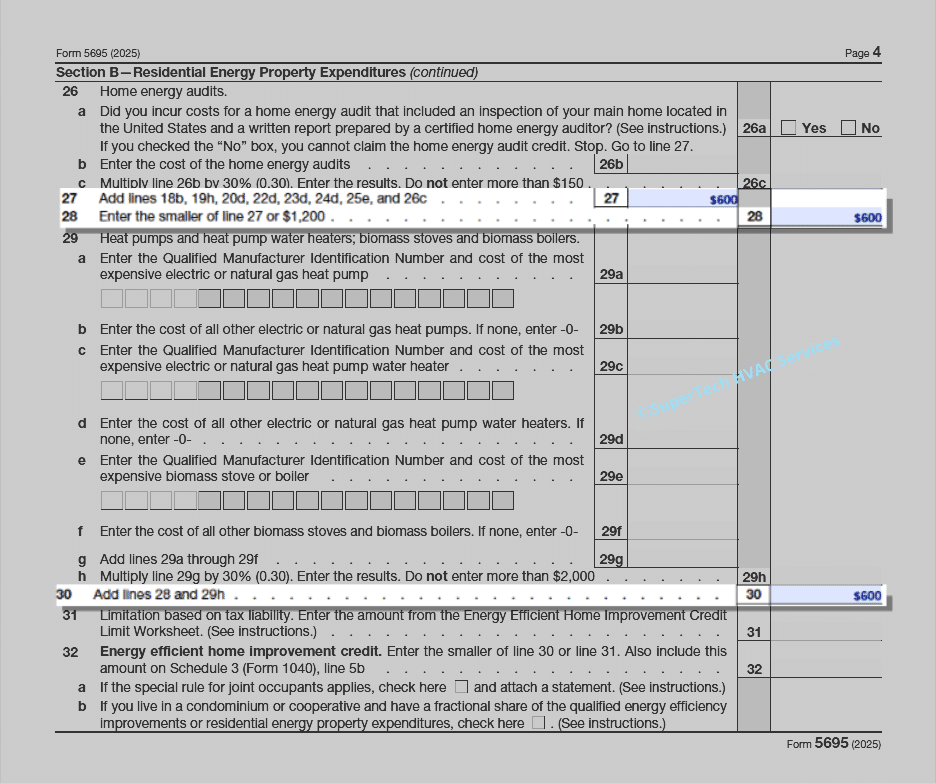
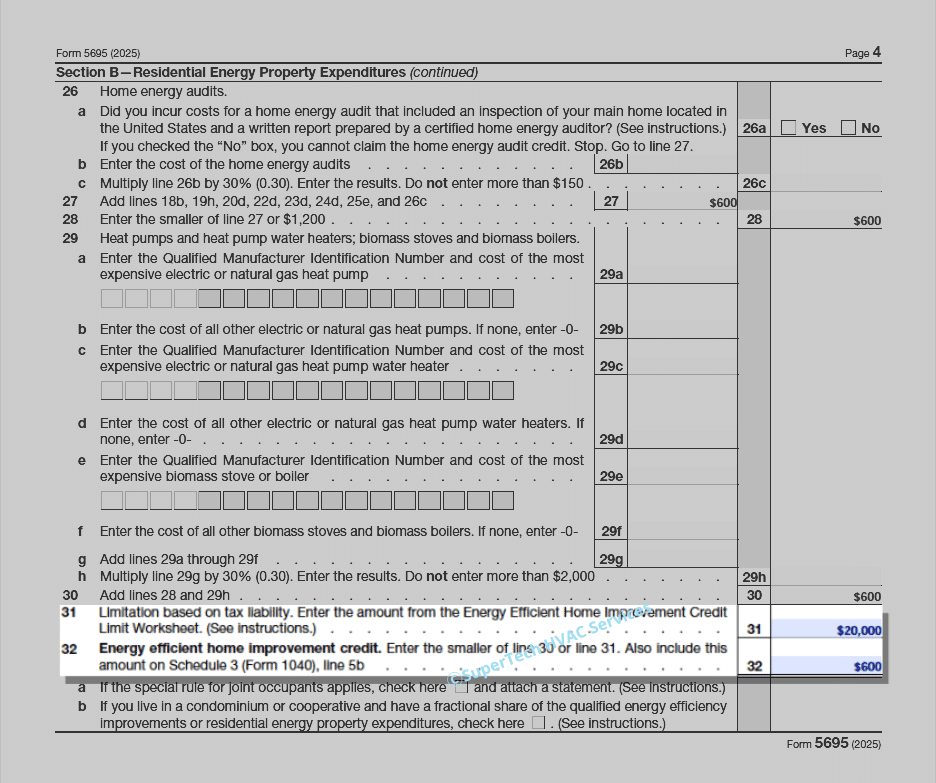
Assuming your limitation (based on tax liability) from the Energy Efficient Home Improvement Credit Limit Worksheet is $20,000:
- Enter $20,000 on Line 31 and $600 on Line 32
We'll Eliminate All Your Concerns About Buying A New System!
Scenario 2: Qualified Heat Pump System (no furnace)
- Enter L7S0 (Lennox) and $15,000 on Line 29a

- Enter $0 on Lines 29b, 29d, 29f and $15,000 on Line 29g
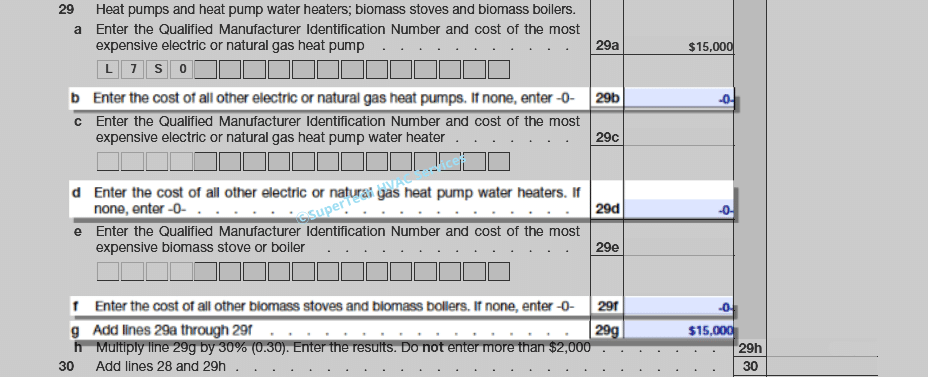
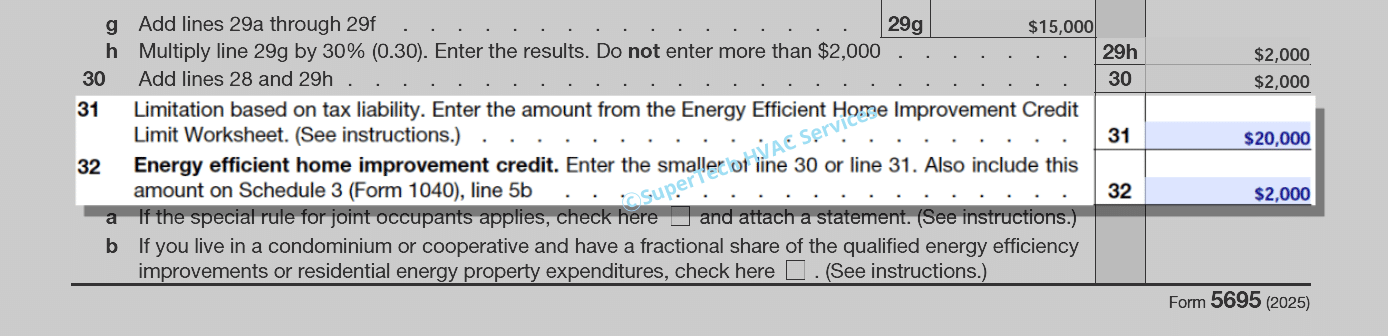
- Enter $2,000 on Line 29h and Line 30

- Enter $20,000 on Line 31 and $2,000 on Line 32
Scenario 3: Qualified Furnace only (no A/C, no heat pump)
- Enter L7S0 (Lennox) and $7,000 on Line 24a

- Enter $0 on Line 24b,$7,000 on Line 24c, and $600 on Line 24d
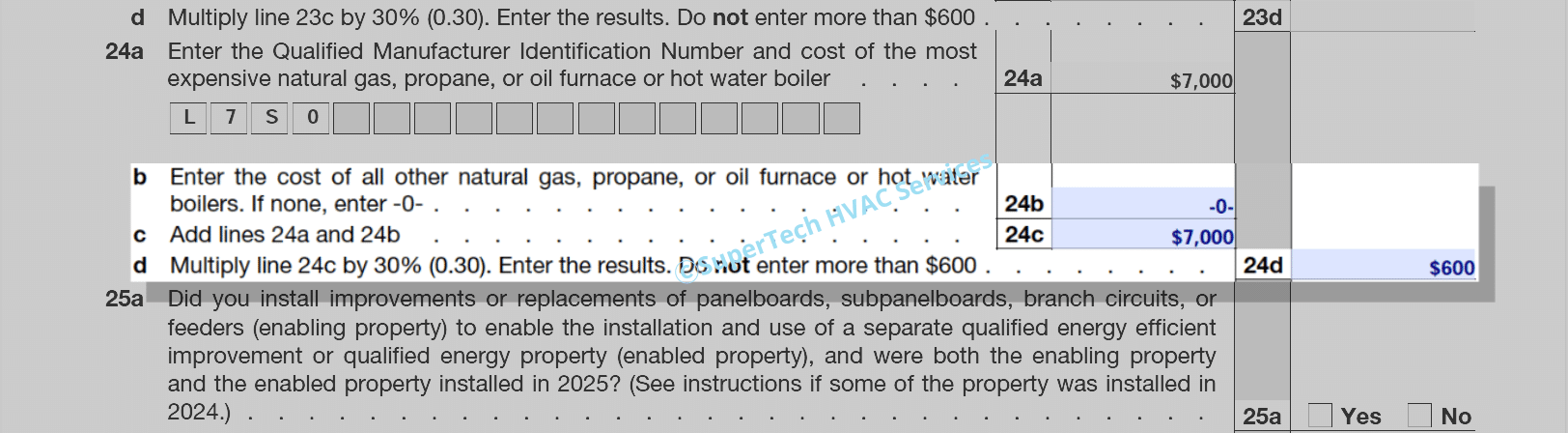
- Enter $600 on Lines 27, 28, and 30
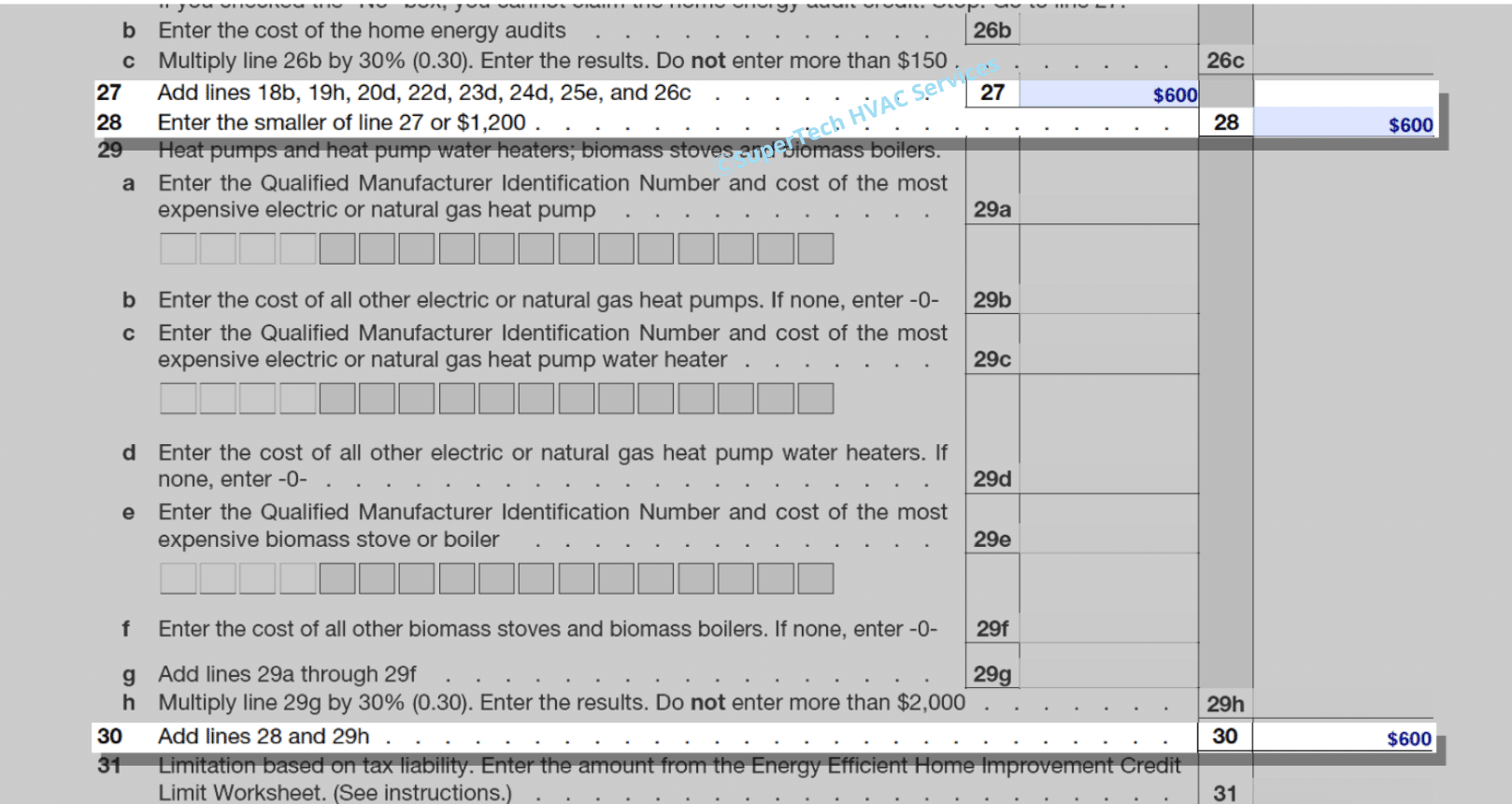
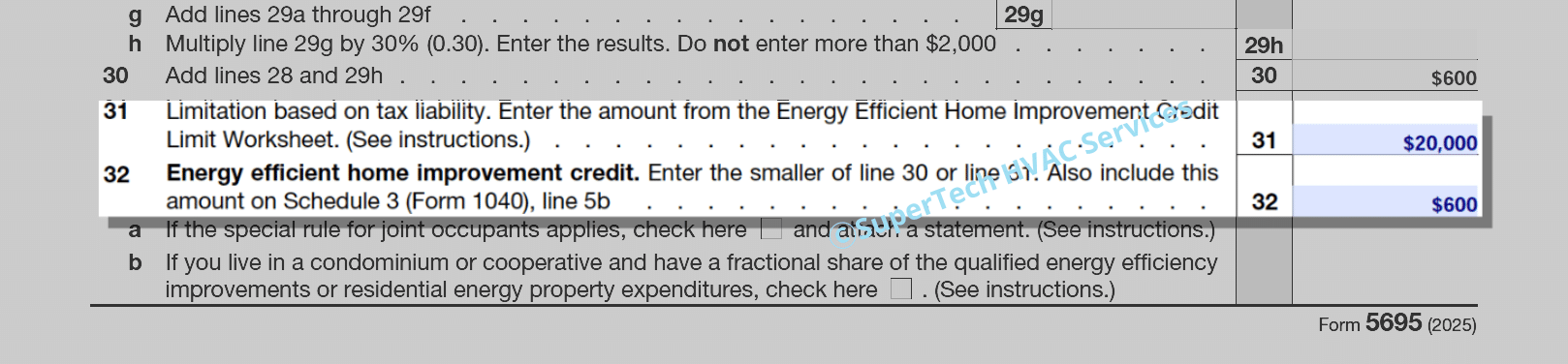
Assuming your limitation (based on tax liability) from the Energy Efficient Home Improvement Credit Limit Worksheet is $20,000:
- Enter $20,000 on Line 31 and $600 on Line 32
Get the Best Heating Solution for Your Home Now!
Scenario 4: Qualified Central A/C System and Furnace Bundle
- $8,000 for the A/C
- $4,500 for the furnace
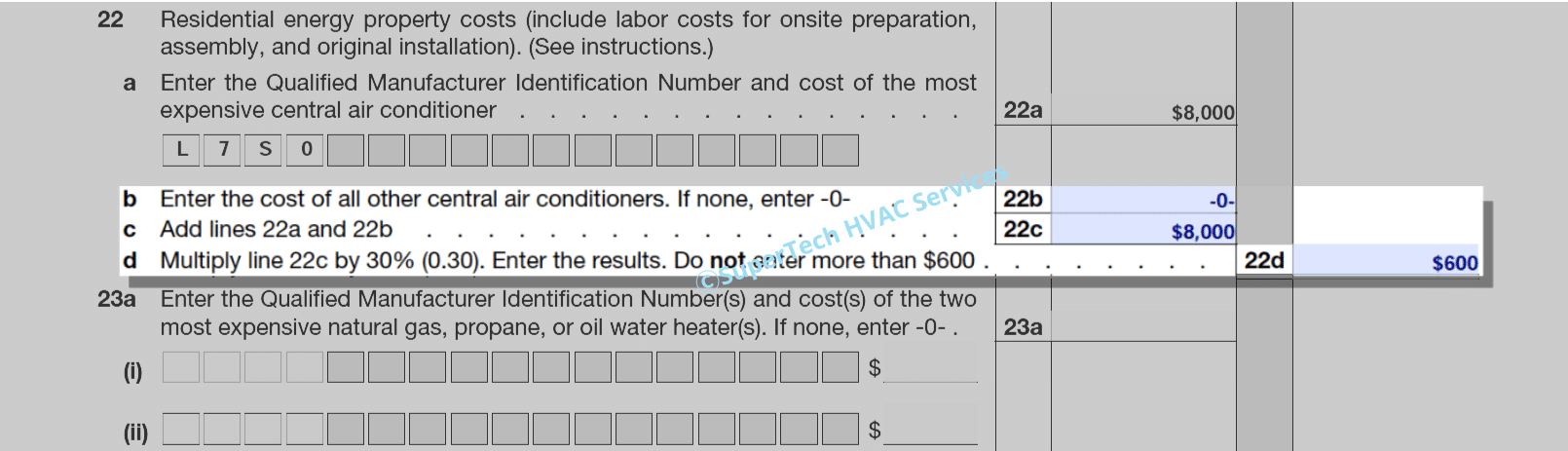
- Enter L7S0 (Lennox) and $8,000 on Line 22a
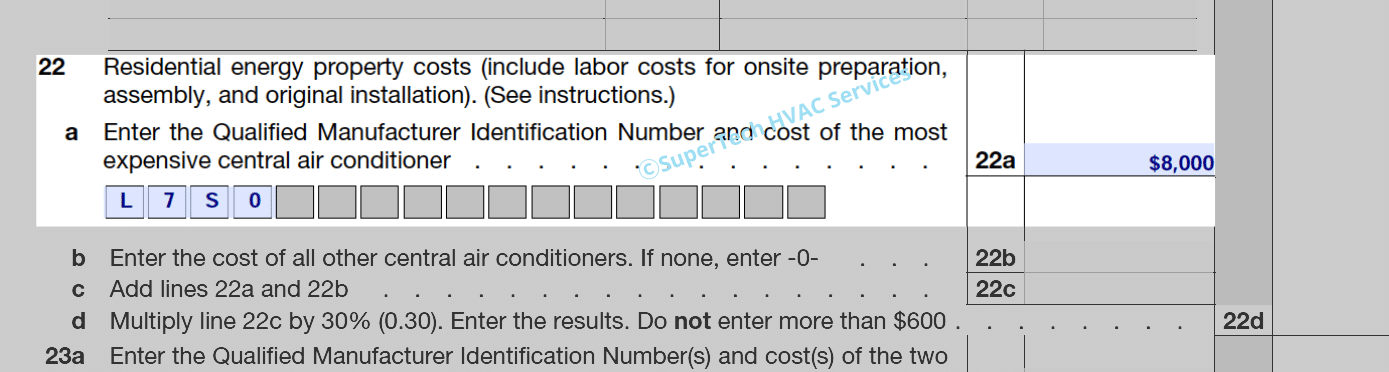
- Enter $0 on Line 22b, $8,000 on Line 22c, and $600 on Line 22d
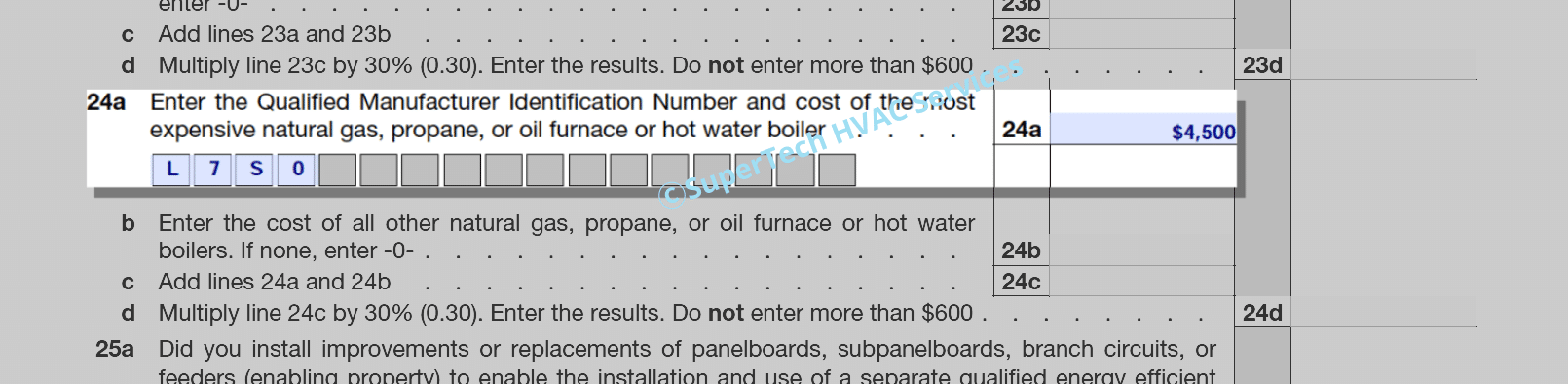
- Enter L7S0 (Lennox) and $4,500 on Line 24a
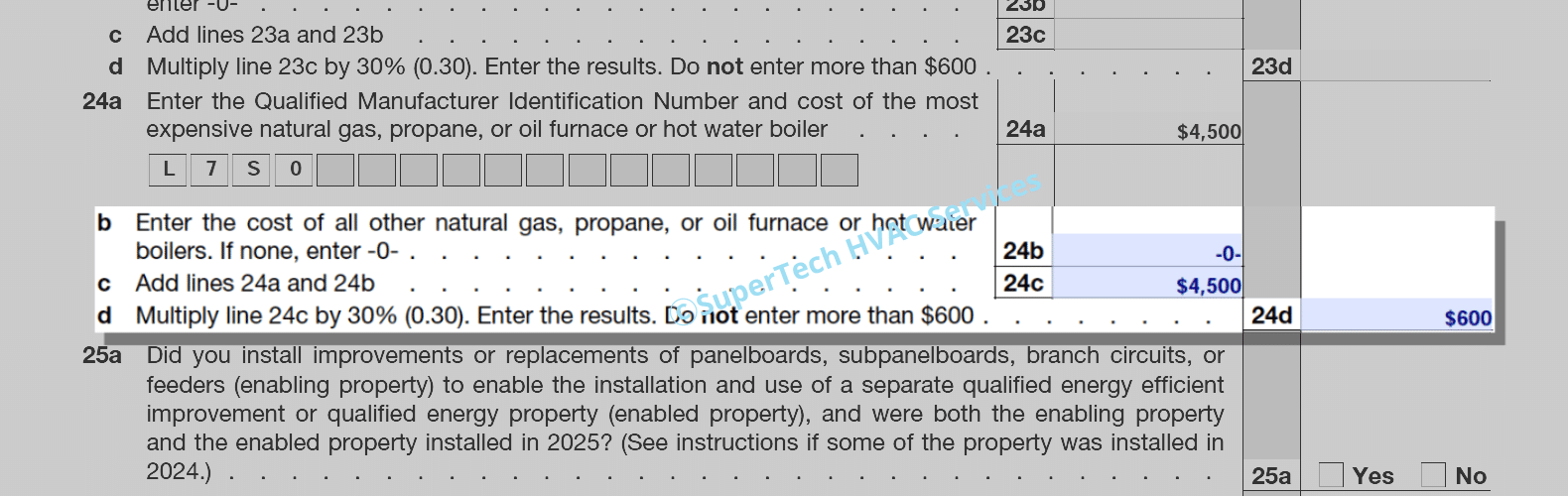
- Enter $0 on Line 24b, $4,500 on Line 24c, and $600 on Line 24d
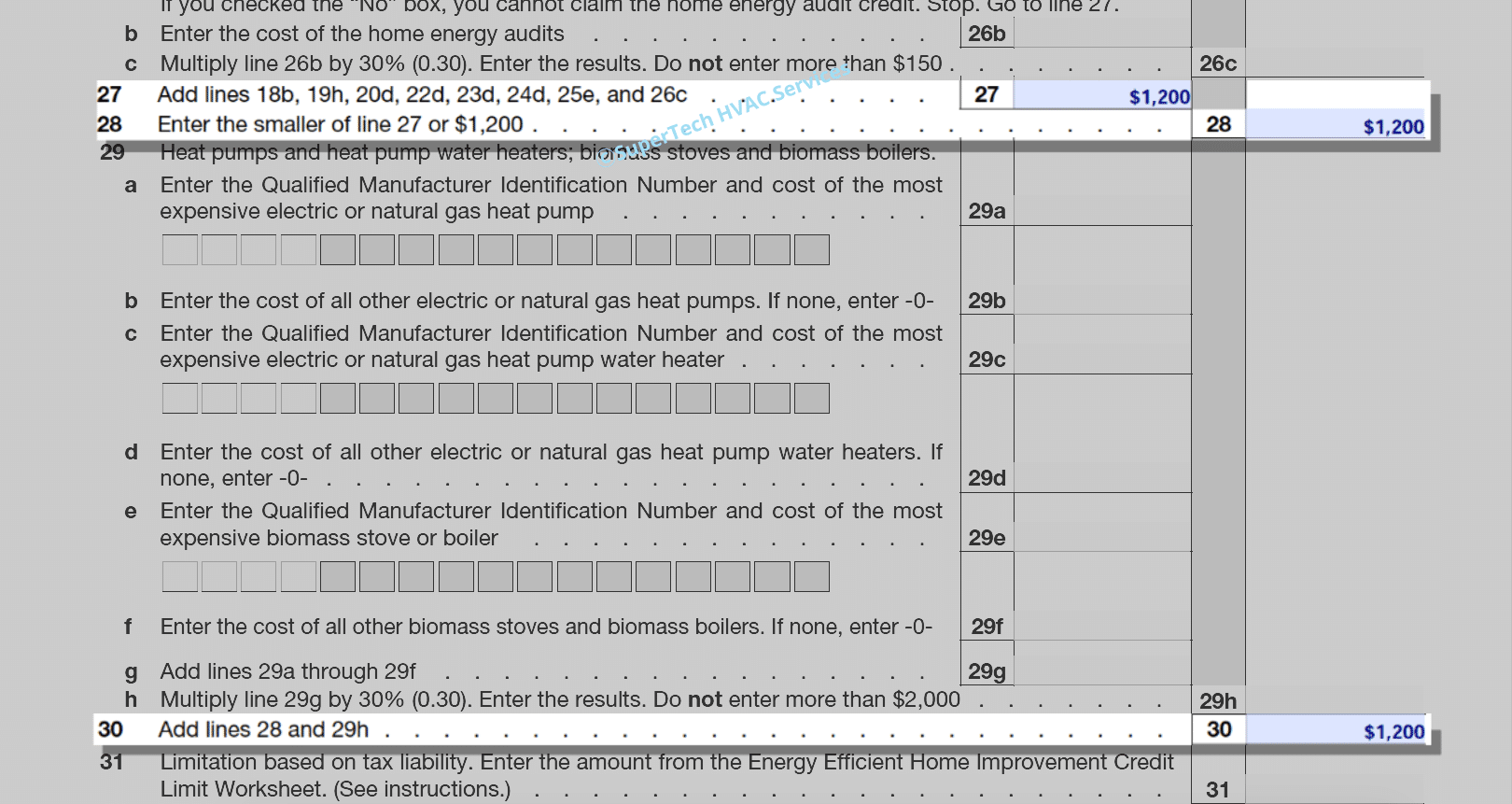
- Enter $1,200 on Lines 27, 28, and 30
- Enter $20,000 on Line 31 and $1,200 on Line 32
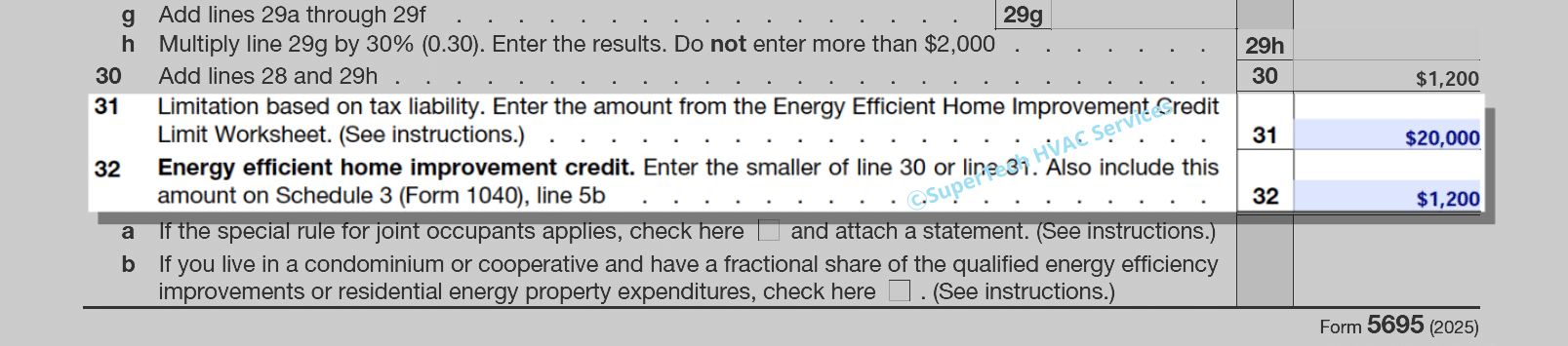
Scenario 5: Qualified Heat Pump System and Furnace Dual Fuel Bundle
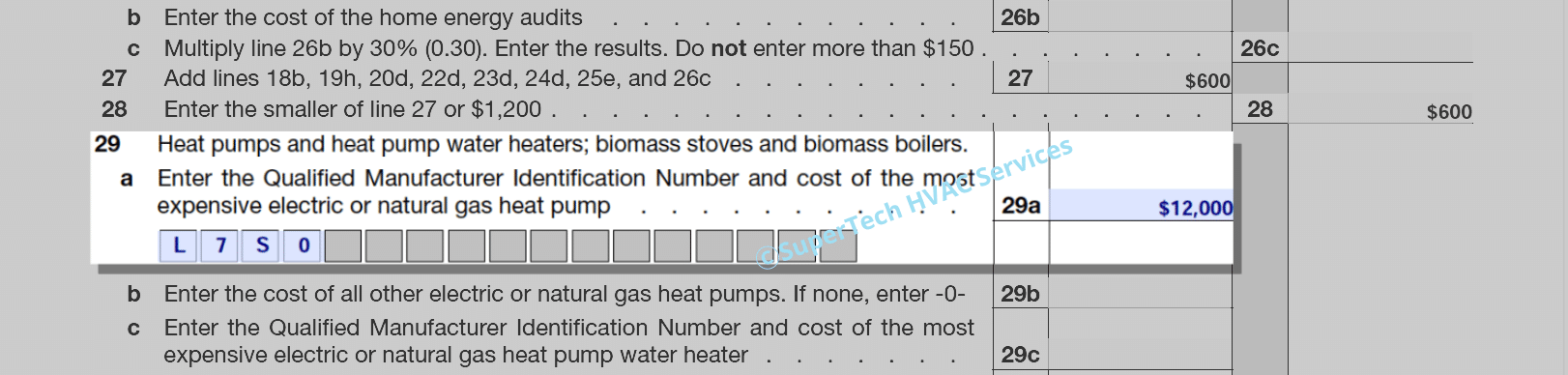
- $12,000 for the heat pump
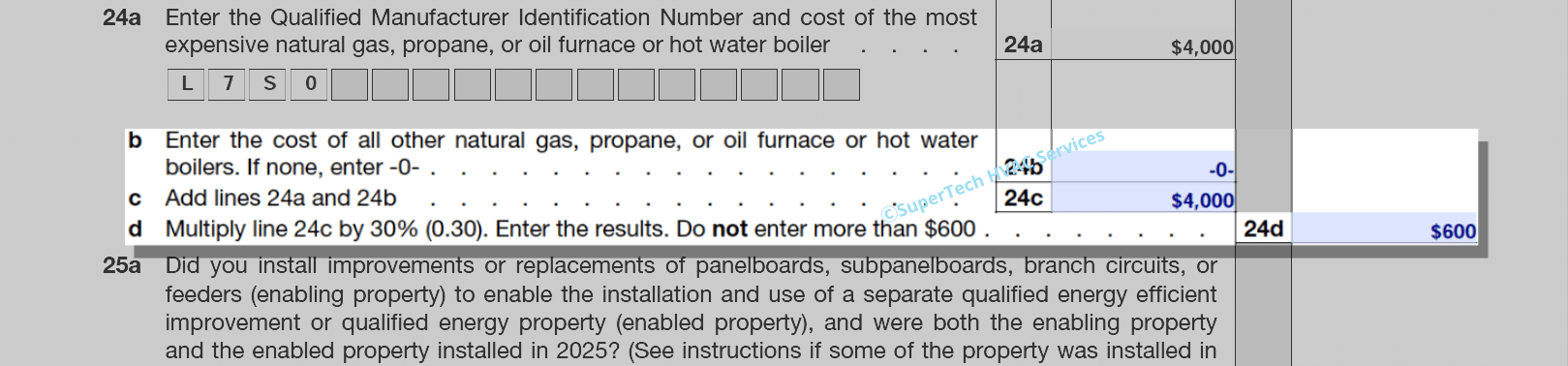
- $4,000 for the furnace
- Enter L7S0 (Lennox) and $4,000 on Line 24a

- Enter $0 on Line 24b, $4,000 on Line 24c, and $600 on Line 24d
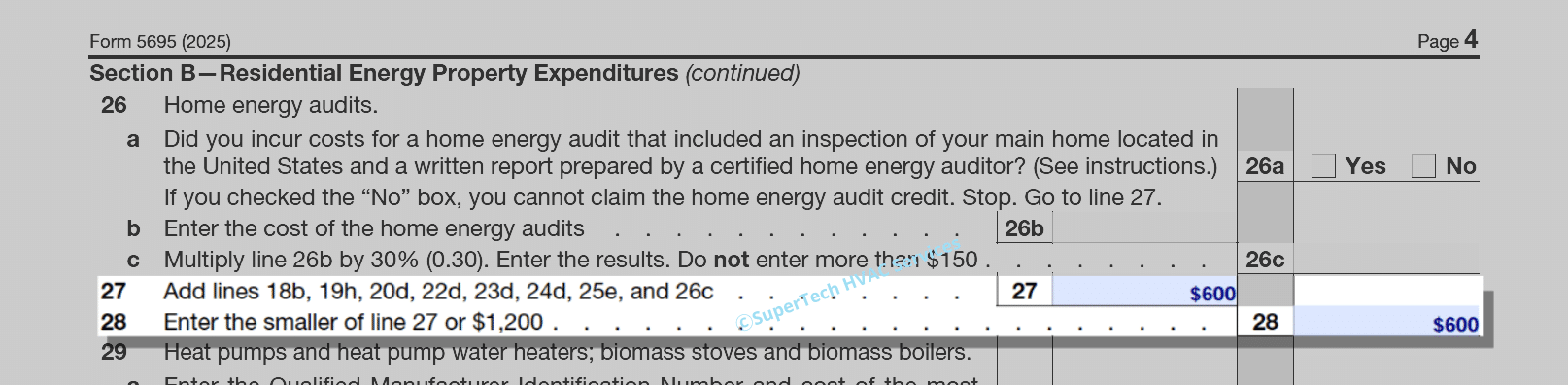
- Enter $600 on Lines 27 and 28
- Enter L7S0 (Lennox) and $12,000 on Line 29a
- Enter $0 on Lines 29b, 29d, 29f, and $12,000 on Line 29g
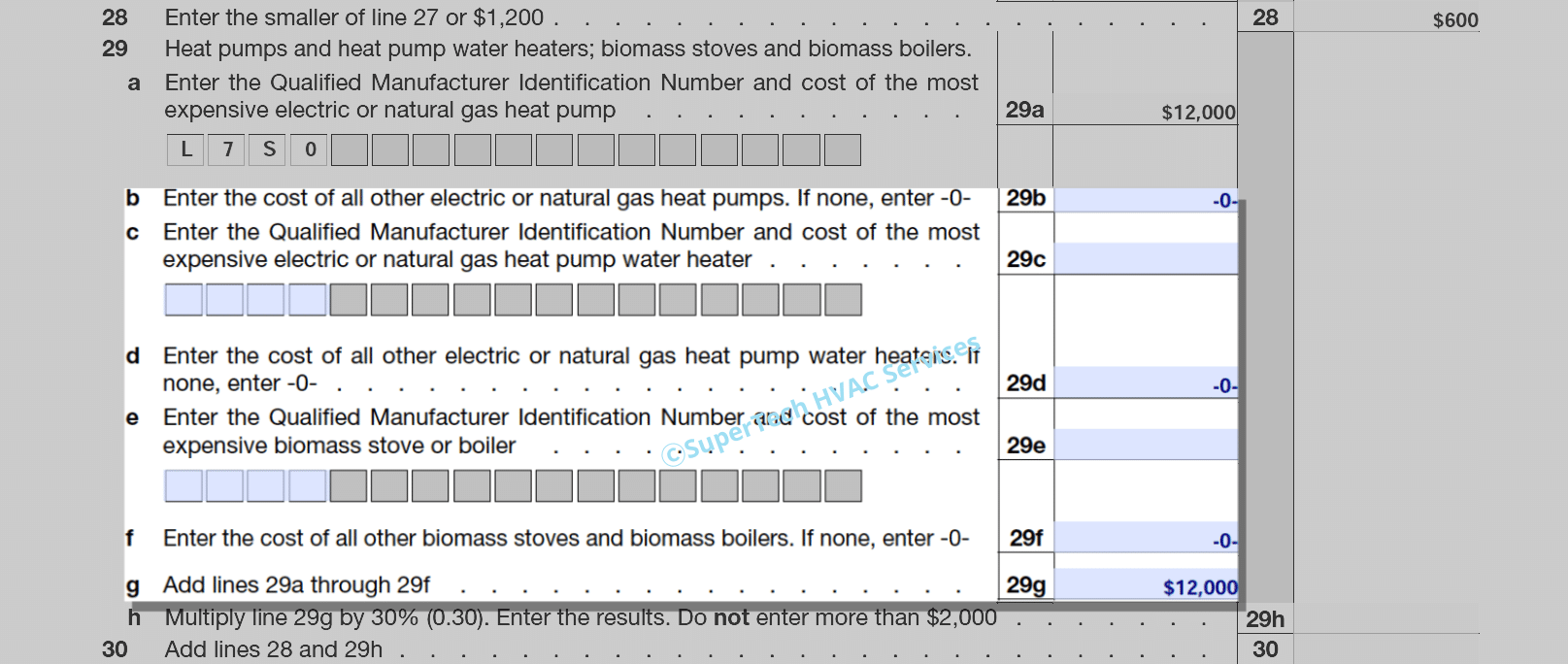
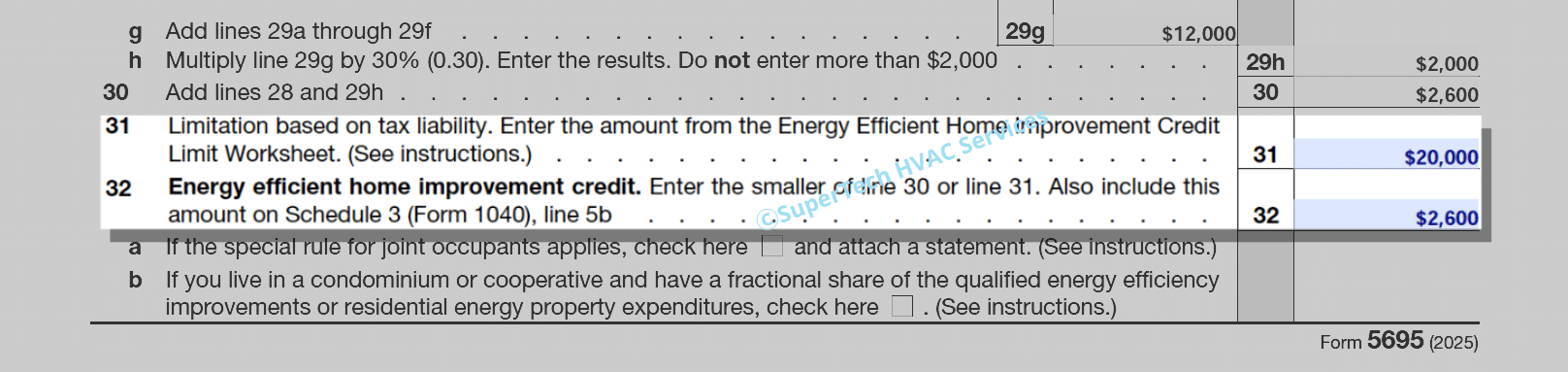
- Enter $2,000 on Line 29h and $2,600 on Line 30

- Enter $20,000 on Line 31 and $2,600 on Line 32
How SuperTech HVAC Can Assist With Your HVAC System Installation
The federal tax credit for high efficiency HVAC systems is an excellent scheme that you should undoubtedly take advantage of. As well as being reimbursed for some of the upfront costs of a new system. Heat pumps and furnaces can also qualify for additional rebates and incentives, which we break down in our detailed heat pump vs. furnace comparison. You will also save money in the long run, as a new, highly-efficient HVAC system costs a lot less to run than other, older systems.
At SuperTech HVAC, we offer a broad range of professional services, including new system installations and repairs. We are experts at installing energy efficient HVAC systems across the Baltimore area, that will ensure you are eligible for the federal tax credit. If you want to entrust a highly skilled, professional, family-run team to install a new HVAC system in your home, then give us a call or schedule an appt here and we would be delighted to discuss the ways in which we can help!
Hi , so I claim the tax credit When I filed My taxes at beginning of tax Season?
Yes you can!
Your article is really great. Thanks for sharing valuable information with us. We also provide the best field service management software.
Thank you for stopping by however we are not interested at this time.